Making Resilience Bankable
How Public and Private Capital Can Finance Prevention Before Disaster Strikes
By: Cesar Perez
The financial case for resilience is becoming increasingly difficult to ignore. A 2026 study by the International Finance Corporation, AXA Climate, and Scientific Climate Ratings found that targeted resilience investments representing between 2.4 and 8 percent of an infrastructure asset’s value can deliver some of the strongest benefit-cost ratios available. Its analysis of infrastructure assets in Brazil found that selected measures could protect as much as US$8.60 in asset value for every dollar invested. The report also concluded that investments below 10 percent of asset value can preserve several times their cost while protecting jobs and reducing disruptions to essential services.
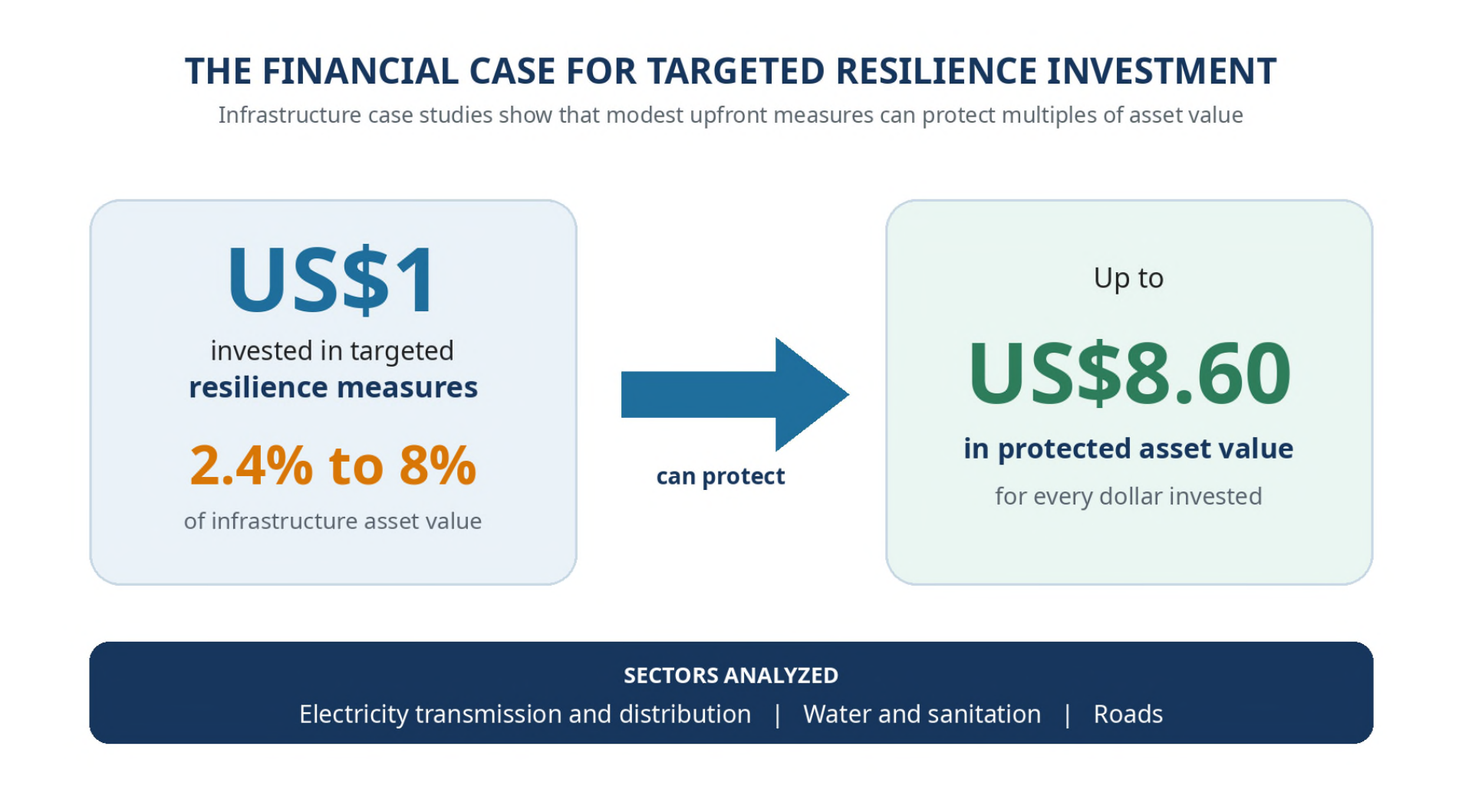
Figure 1: The financial case for targeted resilience investment. Infrastructure case studies found that resilience measures equal to 2.4 to 8 percent of asset value could protect up to US$8.60 in asset value for every dollar invested. Source: International Finance Corporation, AXA Climate, and Scientific Climate Ratings, Low Cost, High Yield: The Adaptation and Resilience Investment Opportunity for Infrastructure (2026).
These findings show that resilience can support financial performance rather than compete with it. Yet a project with a strong economic return is not necessarily a project that commercial investors can finance. Avoided flood damage, uninterrupted electricity, protected employment, and reduced pressure on public budgets create real value, but that value may be distributed across governments, insurers, businesses, households, and future generations. No single party may have both the incentive and the ability to pay for the investment.
This is the central bankability gap. The Resilience Economy identifies a growing market for infrastructure, technologies, financial services, and risk-management systems that reduce future losses. Making that economy investable requires converting widely distributed resilience benefits into revenue, repayment capacity, or measurable savings.
Why Economic Value Does Not Automatically Produce Cash Flow
Traditional project finance depends on identifiable income. A power project may generate revenue through electricity sales. A toll road collects user fees. A commercial building produces rent. Resilience projects frequently operate differently. A seawall may protect homes, businesses, public infrastructure, tax revenue, and insurance portfolios, but the protection itself does not automatically generate a cash flow for the project owner.
World Bank research on private adaptation investment identifies this disconnect as a major obstacle. It emphasizes the need for governments and development partners to build the business case, address policy and market barriers, and convert national adaptation priorities into investments that private capital can evaluate and finance.
The solution is not to force every public benefit into a purely commercial model. It is to identify who benefits, who can pay, and which financing mechanism is appropriate. Repayment may come through tariffs, availability payments, tax revenue, public-service contracts, concession income, insurance savings, reduced operating costs, or payments linked to measurable performance. Some projects may combine resilience with revenue-producing functions. Others will require public funding because the primary benefits are public goods.
Bankability therefore begins with a clear value proposition. Investors must be able to understand how a project protects cash flow, preserves asset value, reduces operating interruptions, lowers future repair costs, improves insurability, or produces a service for which an identifiable party will pay.
Building the Resilience Capital Stack
No single source of finance can carry every risk associated with resilience projects. The capital structure should instead assign risks to the institutions best positioned to understand, price, and manage them.
Public and philanthropic funding can support climate-risk assessments, feasibility studies, engineering designs, community consultation, legal structuring, environmental reviews, and early-stage project development. Concessional lenders and development finance institutions can provide longer maturities, patient capital, guarantees, subordinated debt, or first-loss protection. Commercial banks and institutional investors can participate once the project’s construction, revenue, political, currency, or technology risks have been reduced to an acceptable level.
Climate Policy Initiative’s review of the Global Innovation Lab for Climate Finance shows how this process can work. As of the end of its ninth annual cycle in 2023, the Lab had supported 68 financial instruments, 17 of which focused specifically on adaptation. Of those 17, 12 mobilized capital. Collectively, the Lab’s adaptation portfolio mobilized more than US$1.2 billion. Its research identifies five essential steps: define the adaptation thesis, develop a pipeline with viable cash flows, structure the instrument around investor risk and return, build partnerships, and measure results that matter to investors and beneficiaries.
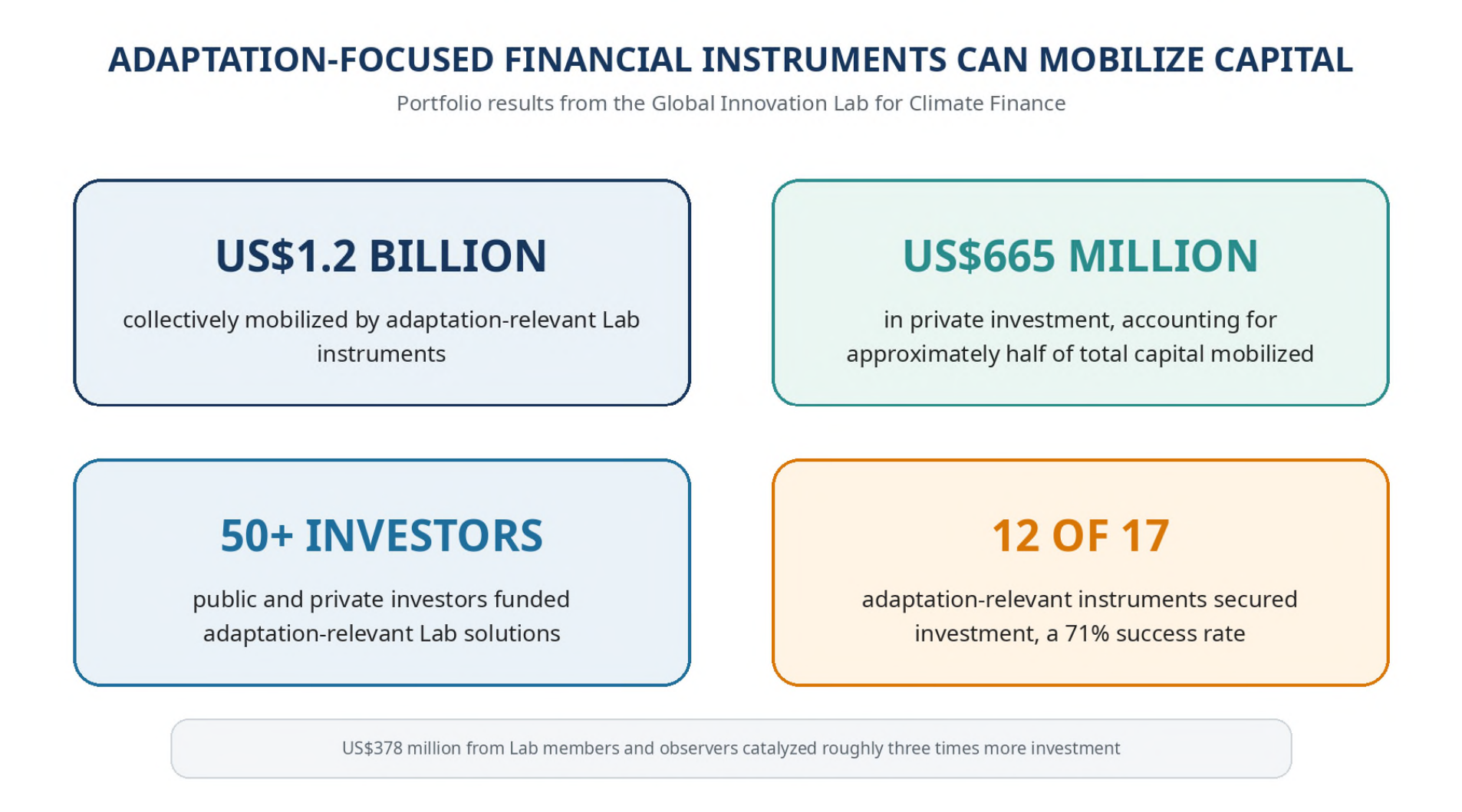
Figure 2: Capital mobilization by adaptation-relevant Lab instruments. Of 17 adaptation-relevant instruments, 12 secured investments, a 71 percent success rate. The Lab’s adaptation portfolio collectively mobilized more than US$1.2 billion, including US$665 million in private investment, from more than 50 public and private investors. Source: Richmond, Lee, and Maguire, Building Financial Instruments for Climate Adaptation: Lessons from the Global Innovation Lab for Climate Finance (Climate Policy Initiative, 2024).
This evidence also offers an important warning. Blended finance should not become a general subsidy for projects that cannot demonstrate value. Concessional capital should address a specific barrier, such as an unproven business model, high preparation costs, limited historical data, currency risk, or a maturity period that commercial markets cannot provide.
The IFC infrastructure study found that longer financing tenors can improve bankability more effectively than interest-rate reductions alone. That finding is particularly relevant for resilient infrastructure, where the upfront investment may be modest compared with benefits realized across several decades. Development institutions can therefore add value by extending the time horizon of capital, not merely by lowering its price.
Financial Instruments Before Disaster
A resilience capital stack can include commercial debt, equity, concessional finance, guarantees, green and resilience bonds, parametric insurance, catastrophe bonds, public-private partnerships, and contingent credit. These instruments perform different functions and should not be treated as interchangeable.
Green or resilience bonds can connect eligible projects with capital-market investors, but a label does not create repayment capacity. The issuer must still have creditworthiness, a pipeline of qualified projects, credible use-of-proceeds controls, and transparent impact reporting.
Insurance and catastrophe bonds address a different need. They transfer defined risks and provide liquidity when predetermined conditions are met. Jamaica’s 2024 catastrophe bond provided US$150 million in hurricane protection through a parametric structure linked to storm path and intensity. Hurricane Melissa triggered a full payout in 2025, demonstrating the value of financing arranged before a disaster rather than negotiated during recovery.
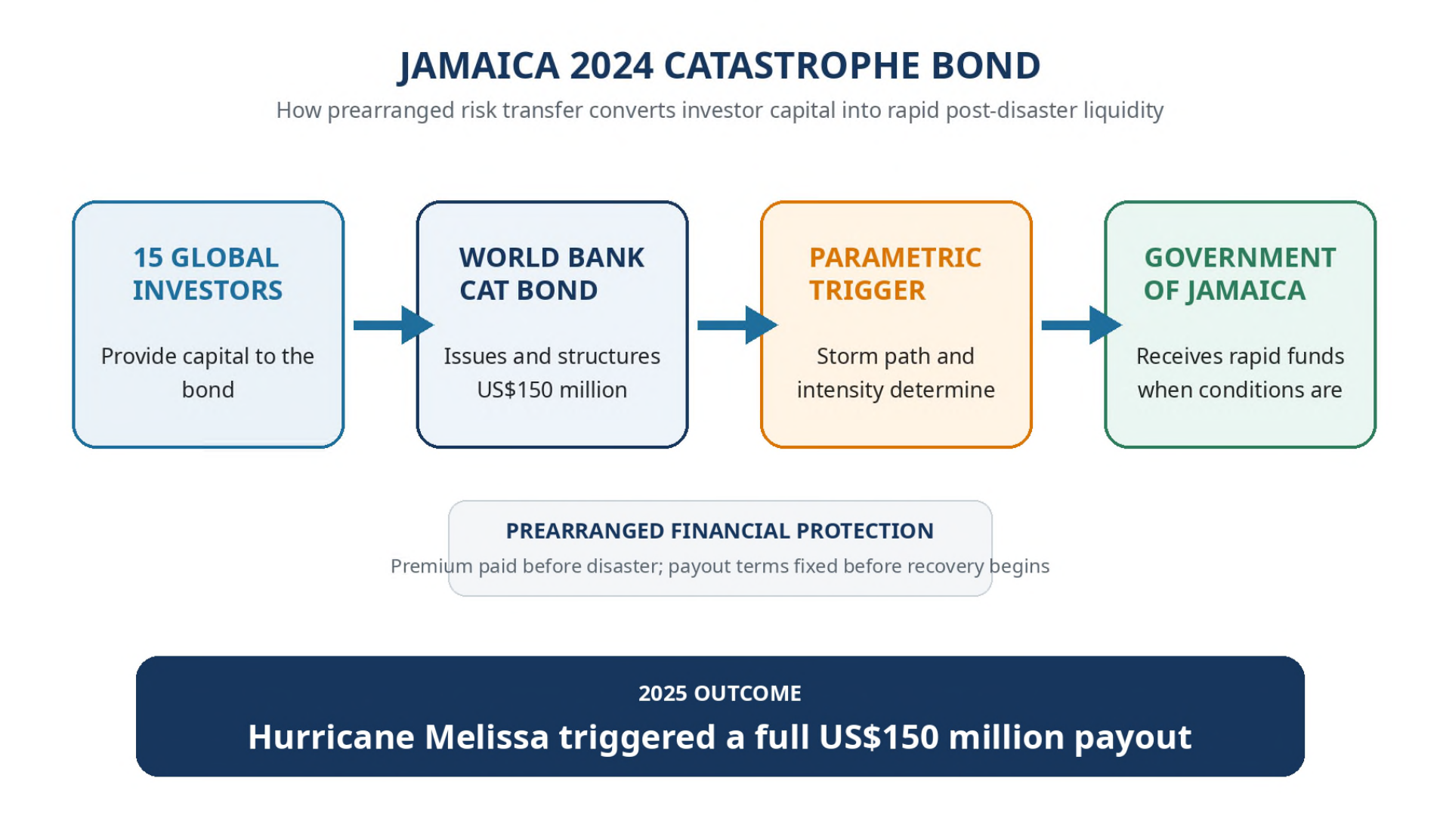
Figure 3: Jamaica’s 2024 catastrophe bond as prearranged disaster-risk finance. The World Bank placed US$150 million in hurricane protection with 15 global investors through a parametric trigger based on storm path and intensity. Hurricane Melissa triggered a full payout in 2025. Source: World Bank, World Bank Returns to the Cat Bond Market Providing Financial Protection to Jamaica (2024), and Hurricane Melissa Triggers 100% Payout of $150 Million World Bank Catastrophe Bond for Jamaica (2025).
The Jamaica transaction strengthened fiscal resilience, but it did not finance seawalls, stronger buildings, or upgraded drainage. Risk transfer and physical prevention are complementary. Insurance provides liquidity after an event, while preventive investment reduces the severity of the losses that insurance must cover. A complete resilience strategy requires both.
Measuring the Resilience Dividend
Investors cannot consistently allocate capital to outcomes they cannot identify or compare. Resilience finance therefore requires credible baselines, climate scenarios, stress testing, operational indicators, and evidence that an intervention reduces risk.
The World Bank Group’s Resilience Rating System provides a useful distinction. It evaluates the resilience of the project, meaning whether the investment can continue achieving its objectives despite climate and disaster risks, and resilience through the project, meaning whether it strengthens the capacity of communities, beneficiaries, or wider systems to withstand shocks. The system assigns ratings from C to A+ and can support project design, portfolio assessment, and reporting.
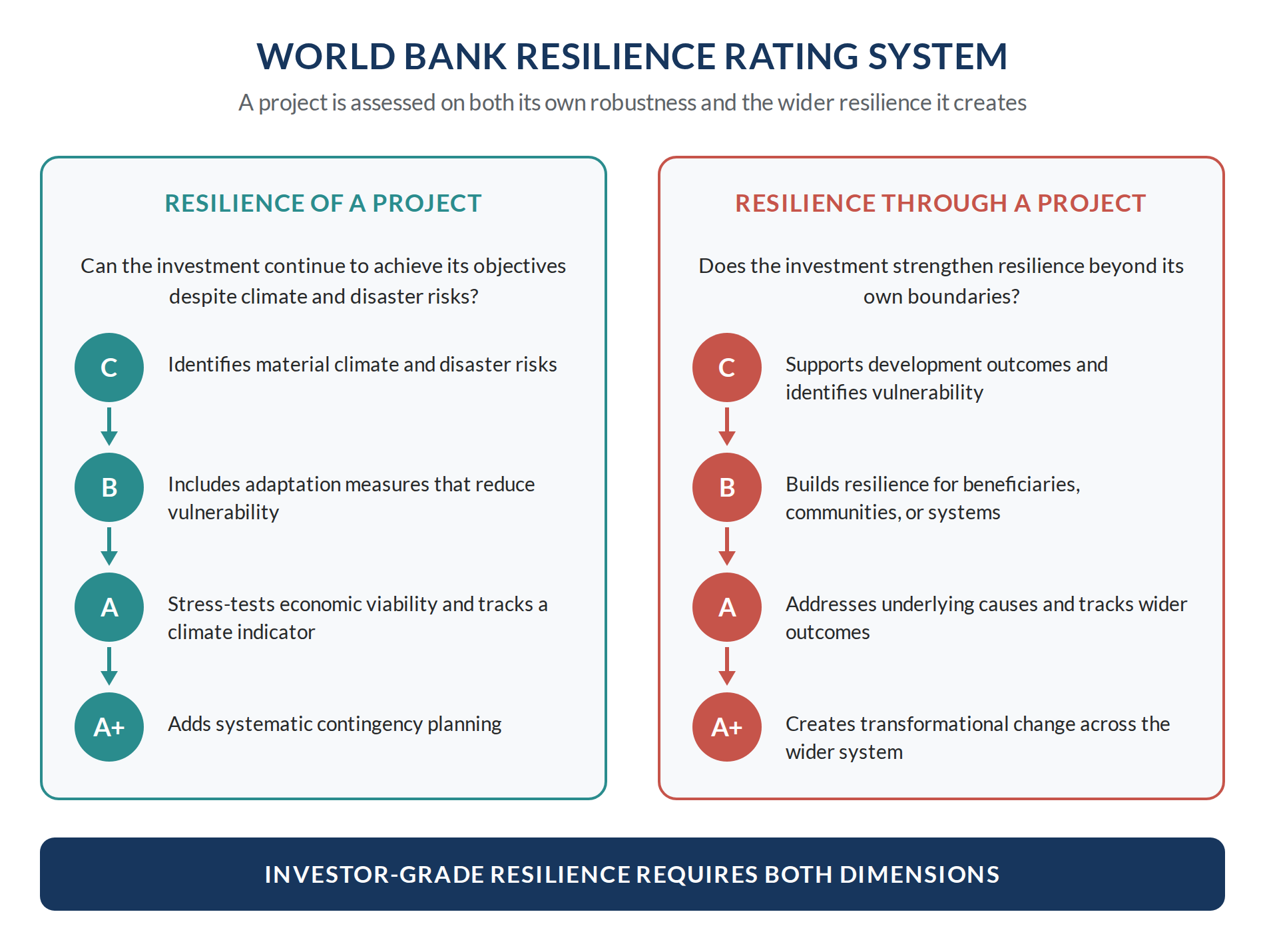
Figure 4: The two dimensions of the World Bank resilience rating system. The framework distinguishes resilience of a project from resilience through a project, with ratings from C to A+ based on climate-risk management, economic robustness, wider resilience outcomes, and monitoring. Source: World Bank Group, Resilience Rating System: A Methodology for Building and Tracking Resilience to Climate Change (2021).
This distinction is essential. A privately operated asset may be engineered to protect its own revenue while providing little resilience to the surrounding community. Conversely, an investment may strengthen public resilience but remain financially unsustainable. A credible project must clarify both dimensions.
The International Capital Market Association’s impact-reporting guidance provides potential indicators for adaptation projects, including reduced service interruptions, fewer power lines incapacitated during storms, increased access to resilient energy systems, improved flood protection, and shorter periods between disaster and recovery. Such measures help translate resilience from a broad aspiration into observable performance.
The Public Sector Creates the Market
Private capital will not independently solve a problem shaped by public goods, uncertain climate risk, fragmented beneficiaries, and long investment horizons. Governments determine whether the enabling environment supports or discourages resilience investment.
The OECD’s Climate Adaptation Investment Framework identifies several public responsibilities: establishing clear adaptation objectives, providing reliable climate-risk data, updating building and technical standards, incorporating lifecycle resilience benefits into public appraisal, managing climate risks in public-private partnerships, supporting project-preparation facilities, and promoting credible standards and taxonomies. It also emphasizes that public and private investment are both essential.
Government action should create a transparent pipeline of priority projects rather than a collection of disconnected funding requests. Development banks can help convert those priorities into feasibility studies, procurement structures, financial models, and investable transactions. Guarantees and concessional resources can then be applied selectively, with clear objectives and measurable additionality.
This approach changes the role of public finance. Instead of functioning primarily as the payer of last resort after disasters, government capital becomes a strategic tool for preparing projects, absorbing risks that markets cannot efficiently carry, and attracting private capital before losses occur. UNDRR argues that investing in prevention is fundamental to effective risk governance, yet governments continue to underinvest in prevention and resilience despite escalating losses.
From Bankable Projects to Public Value
Bankability is necessary, but it is not sufficient. A financially successful project can still transfer risk to vulnerable communities, exclude lower-income households, protect high-value assets while neglecting essential public systems, or generate private returns without strengthening collective resilience.
Resilience Capitalism provides the governance test. Capital should be judged not only by whether it reaches financial close, but by whether it reduces future exposure, strengthens adaptive capacity, improves institutional readiness, distributes benefits fairly, and creates lasting public value.
The Resilience Economy describes where investment can flow. Making resilience bankable explains how it can flow. Resilience Capitalism determines the conditions under which that flow should be considered economically, socially, and institutionally successful.
The objective is not to convert every resilience need into a commercial product. It is to build financing structures appropriate to the value each project creates. Where reliable revenues exist, commercial capital should be mobilized. Where benefits are shared broadly, public finance should compensate for market failures. Where risk prevents participation, development institutions should provide targeted support. Where communities bear the consequences, they should participate in project design and benefit allocation.
The next generation of resilient infrastructure will not be financed through one instrument or one class of investor. It will be built through capital stacks that recognize risk, reward prevention, measure outcomes, and protect the public interest. Making resilience bankable is therefore more than a financial exercise. It is the practical mechanism through which societies begin paying for the disasters they prevent rather than only for the destruction they fail to avoid.
Sources: International Finance Corporation, AXA Climate, and Scientific Climate Ratings, Low Cost, High Yield: The Adaptation and Resilience Investment Opportunity for Infrastructure (2026) · World Bank, Enabling Private Investment in Climate Adaptation and Resilience (2021) · Climate Policy Initiative, Building Financial Instruments for Climate Adaptation: Lessons from the Global Innovation Lab for Climate Finance (2024) · World Bank, World Bank Returns to the Cat Bond Market Providing Financial Protection to Jamaica (2024) and Hurricane Melissa Triggers 100% Payout of $150 Million World Bank Catastrophe Bond for Jamaica (2025) · World Bank Group, Resilience Rating System: A Methodology for Building and Tracking Resilience to Climate Change (2021) · International Capital Market Association, Handbook: Harmonised Framework for Impact Reporting (2024) · OECD, Climate Adaptation Investment Framework (2024) · UN Office for Disaster Risk Reduction, Policy Brief: Financing Prevention and De-risking Investment (2022)