The Resilience Economy
Why the Next Trillion-Dollar Investment Opportunity Should be Built Before the Next Disaster
By: Cesar Perez
The world’s largest climate investment opportunity may not be reconstruction after catastrophe. It may be the systems that let economies, infrastructure, and communities keep functioning when disaster hits.
The United Nations Office for Disaster Risk Reduction puts direct disaster losses at more than $200 billion a year. Add the disruption to health, education, livelihoods, supply chains, and ecosystems, and the real annual cost tops $2.3 trillion. That isn’t just a humanitarian toll — it’s a steady drain on public wealth, private assets, and fiscal capacity, one most capital still treats as somebody else’s problem.
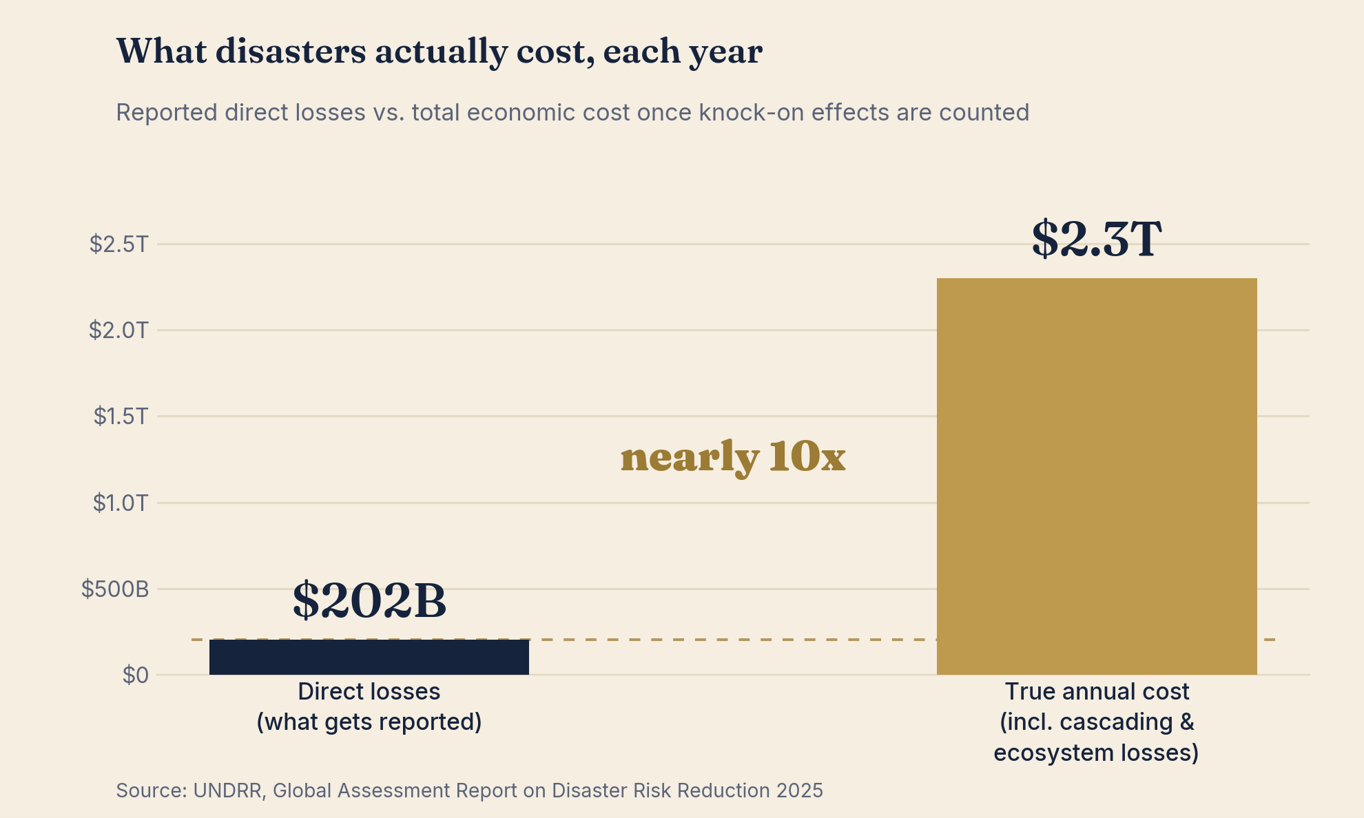
Figure 1: Reported direct disaster losses compared with the true annual economic cost, once cascading and ecosystem losses are counted. Source: UNDRR, Global Assessment Report on Disaster Risk Reduction 2025.
The case for acting first is already strong. The World Bank’s Lifelines research puts the net benefit of more resilient infrastructure in low- and middle-income countries at $4.2 trillion — roughly four dollars back for every dollar spent. At that scale, resilience stops looking like insurance and starts looking like its own asset class: the Resilience Economy.
The Limits of Reactive Finance
The conventional disaster-financing model still moves capital after the damage is done. Governments approve emergency spending, insurers pay claims, development banks fund recovery, and households and businesses borrow or draw down savings. Reconstruction restores what was lost, but it rarely changes the underlying exposure. Money keeps arriving after the fact, while comparatively little goes toward lowering the odds or the size of the next loss.
The adaptation finance gap shows just how lopsided that is. The UN Environment Programme estimates developing countries will need $310 billion to $365 billion a year by 2035 to adapt. International public adaptation finance came in at just $26 billion in 2023 — twelve to fourteen times short of what’s needed. UNEP sees room for private finance to add roughly $50 billion a year, if it’s backed by the right policy and blended-finance structures. This isn’t only a capital shortage. It’s a shortage of bankable pipelines, incentives, risk-sharing structures, and institutional capacity to move money toward prevention.
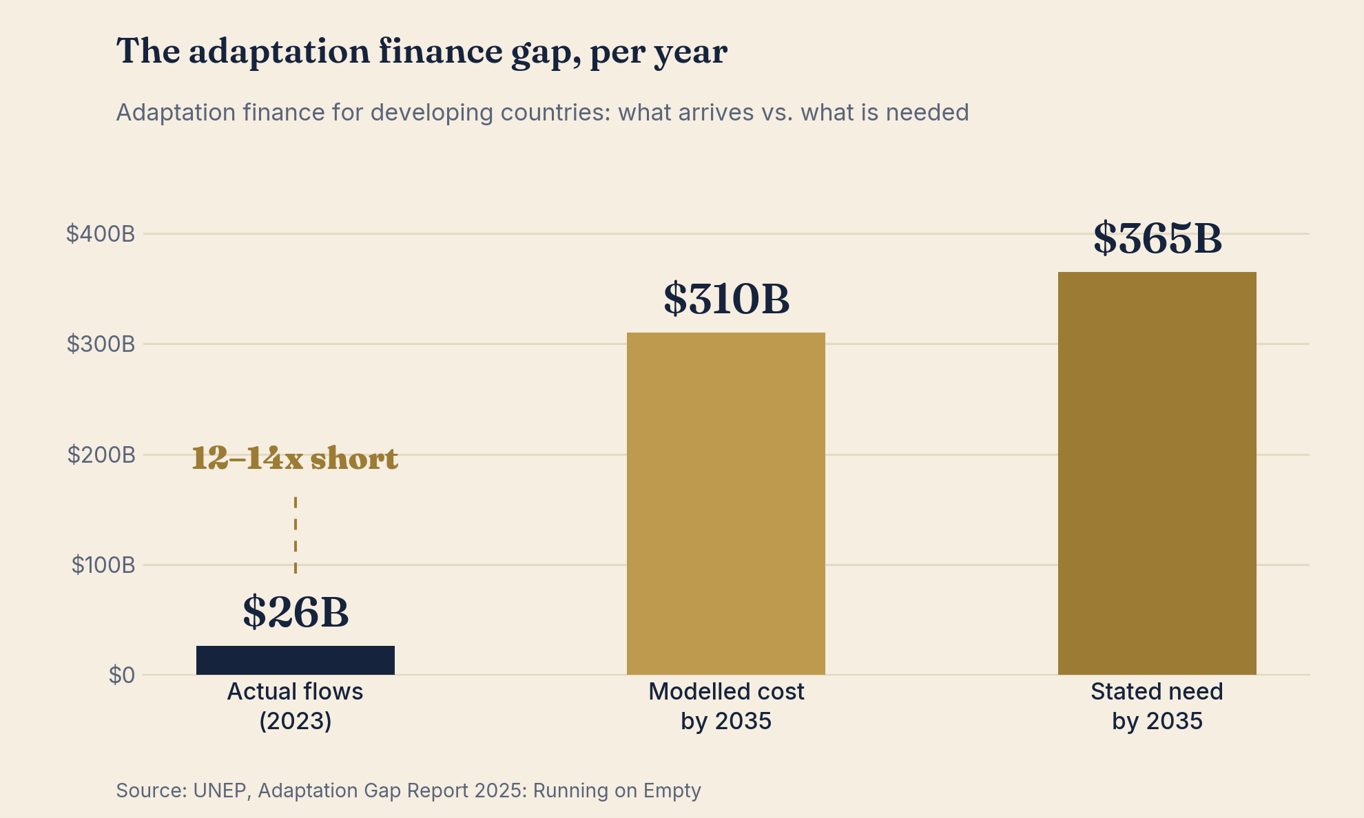
Figure 2: Adaptation finance for developing countries — what arrives each year versus what is needed. Source: UNEP, Adaptation Gap Report 2025: Running on Empty.
Insurance markets show why waiting gets expensive fast. As physical risk climbs, so do premiums, deductibles, coverage limits, and asset valuations — passing the cost of vulnerability on to property owners, businesses, lenders, and local governments. Swiss Re Institute argues proactive flood adaptation cuts damage while keeping insurance available and affordable, producing steadier outcomes than repeated rebuilding. That creates a virtuous cycle: better protection lowers expected losses, lower losses improve insurability and credit quality, and better financing terms make the next round of resilience investment easier to fund. Skip the early investment, and the cycle runs in reverse — shrinking coverage, retreating capital, and growing reliance on public recovery funds.
Where the Resilience Economy Is Taking Shape
The Resilience Economy spans the assets, services, technologies, and financial instruments that reduce physical climate risk and keep the lights on: climate-resilient transport, water and sanitation, stronger grids, distributed energy, flood protection, resilient housing, cooling systems, drought-resistant agriculture, ecosystem restoration, early-warning systems, climate analytics, supply-chain risk management, and insurance that pays out fast after a predefined event. These sectors get treated as separate markets. Economically, they do the same job: protect the systems the rest of the economy depends on.
Infrastructure shows the scale most clearly. The OECD puts the global sustainable infrastructure bill at $6.9 trillion a year through 2030. Applying World Bank estimates, it calculates that building resilience into power, transport, water, and sanitation projects would add only about 3 percent to that total — roughly $207 billion a year — to protect assets that will operate for decades under changing climate conditions.
That opportunity isn’t landing evenly. The OECD found the private sector invested about $424 billion in infrastructure projects globally in 2022, but 71 percent of it went to high-income countries, and only a small share was identified as climate resilient. The places that need resilience most are often the hardest to finance — higher costs, thinner institutions, and risk perceptions that keep capital away.
Converting Resilience into Investable Value
Resilience investments create value well beyond avoided damage. They protect business continuity, tax revenue, public health, productivity, and property values, and they keep transportation, energy, communications, and water running. Much of that value shows up even when no disaster hits — which is exactly why conventional project appraisal tends to undercount it.
The World Resources Institute put real numbers behind that broader return. Reviewing 320 adaptation and resilience projects across agriculture, water, health, and infrastructure — representing more than $133 billion in costs — WRI found they’re expected to generate roughly $1.4 trillion in benefits over ten years. That works out to more than $10.50 back for every dollar invested, with health-sector projects returning the most, and energy, cities, and transport projects not far behind. The point isn’t just that resilience pays. It’s that it pays across nearly every sector you’d invest in anyway.
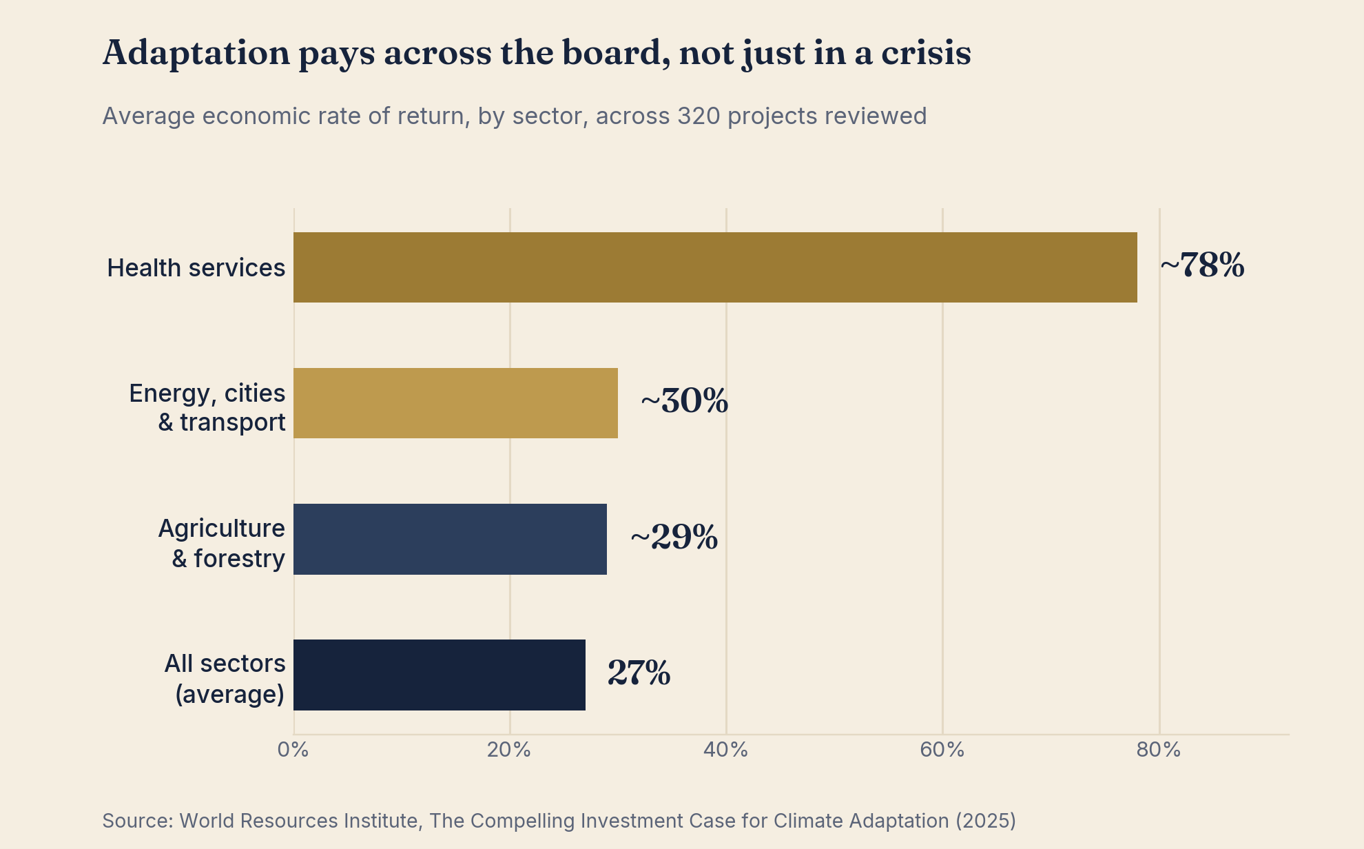
Figure 3: Average economic rate of return by sector across the 320 adaptation and resilience projects reviewed. Source: World Resources Institute, The Compelling Investment Case for Climate Adaptation (2025).
A market is starting to form around that logic. In fiscal year 2025, the International Finance Corporation committed $558 million to adaptation investments and reported $3.7 billion in total capital mobilized. IFC is building bankable opportunities in water, agribusiness, and financial institutions while developing the standards and instruments that draw in private capital. Resilience bonds, blended finance, guarantees, parametric insurance, and public-private partnerships can all grow this market — but only for projects with credible revenue models, measurable risk reduction, and clear accountability.
The next phase of global finance will reward not only capital allocation, but anticipation. As physical climate risk feeds into insurance premiums, sovereign creditworthiness, infrastructure valuations, and corporate balance sheets, investors who recognize its effects before they are fully priced can identify both mispriced risk and undervalued resilience that conventional models overlook. Seen this way, the Resilience Economy is more than a response to climate change. It is an investment framework for moving capital before disruption makes the need obvious, toward assets and systems that prevent losses, preserve economic function, and create durable value. But if resilience is becoming investable, a more difficult question follows: who decides where capital flows, which risks receive protection, and who ultimately shares in the benefits? That is where Resilience Capitalism begins.
From the Resilience Economy to Resilience Capitalism
The Resilience Economy describes where the capital can flow. Resilience Capitalism — the framework we laid out in an earlier piece on this site — is about how that capital should be governed. The distinction matters: investment labeled “resilient” can still shift risk onto renters and vulnerable communities, push up housing costs, or protect commercially valuable assets while leaving public systems exposed. Financial growth on its own doesn’t guarantee anyone is actually safer.
Resilience Capitalism judges investments by whether they cut future exposure, build adaptive capacity, strengthen institutions, and distribute the benefits fairly — not just whether they turn a profit. Public finance can absorb risks private investors won’t touch alone; private capital brings scale and operational know-how. Government’s job is to set the standards and make sure the map of investment doesn’t just retrace the map of vulnerability.
What This Means
The Resilience Economy isn’t a single asset class or a clean forecast. Its trillion-dollar scale comes from the infrastructure that has to get built, the adaptation gap that has to close, and the losses that can still be avoided. As climate risk works its way into asset values, credit decisions, insurance availability, and public budgets, resilience will increasingly decide how capital gets priced — and who it protects.
Investors and asset owners: treat resilience due diligence as a pricing input, not a marketing line — the $10.50-per-dollar return only shows up when the underlying risk reduction is real and measured.
Insurers and lenders: proactive adaptation is a portfolio play, not a client favor — it’s the lever that keeps coverage available and credit quality intact in exposed markets.
Public agencies: the 3-percent resilience premium on infrastructure spending is the cheapest insurance policy on the table — build it into the base case, not the change order.
All three: close the finance gap the way IFC and blended-finance vehicles are starting to — by building bankable pipelines, not just bigger pledges.
The next disaster will still require response and recovery. The bigger opportunity is building the economy that needs less of it.
Sources: UN Office for Disaster Risk Reduction, Global Assessment Report on Disaster Risk Reduction 2025 · World Bank, Lifelines: The Resilient Infrastructure Opportunity · UN Environment Programme, Adaptation Gap Report 2025: Running on Empty · Swiss Re Institute, Resilience or Rebuild? · OECD, Infrastructure for a Climate-Resilient Future and G20/OECD Report on Financing Climate-Resilient Infrastructure· World Resources Institute, The Compelling Investment Case for Climate Adaptation · International Finance Corporation, Climate Resilience