Why Disaster Capitalism
A case for investment, with a cautionary note…
By: Jeff Schlegelmilch
Disaster capitalism has extreme negative connotations in the world of disaster management. Its origins are often attributed to the author and activist Naomi Klein who explored the economic exploitation of disasters through the shock and chaos that often ensues in her book The Shock Doctrine: The Rise of Disaster Capitalism. This lens has been reflected by many in the field of disaster research, noting that (to put it politely) corporate interests are rarely aligned with public good.
We are here to offer an alternative argument. We don’t dispute the negative impacts that a myopic focus on short-term profit leads to. But we also see tremendous potential in the role of the private sector in bringing in critical resources and value into areas of disaster resilience and climate adaptation. There is mutual value to be created for shareholders and society at large, if properly guided by research and evidence, and a recognition that disasters sit at the intersection of many different facets of civil society.
Currently the domain of disaster resilience is primarily in the government sector. An analysis from Tailwind Futures’ Adaptation Finance: A Primer for Practitioners. Essential components of climate adaptation finance identifies this imbalance, with the vast majority of financing for climate adaptation, which covers climate disasters and the broader impacts of climate change. But they go on to look at this not as a deficiency, but as untapped potential for bringing private capital to benefit resilience. This has been followed by reports from groups like JP Morgan, McKinsey, BCG, among many others to release analyses and guides to reduce losses from climate adaptation, as well as take advantage of what are anticipated to exceed $1 trillion USD in investable opportunities in the coming years.
The business case for resilience is being made, and the investable opportunities are becoming real. However, while the capital markets and private sectors have resources and capabilities that could be truly transformational in this space, their incentive structures do not consistently align with public good.
That is why we are here.
While not all problems have a market value, there is a stronger business case to be made for building resilience among communities where businesses build and run their organizations, and where public dollars can be freed up through private sector buy-in, allowing those resources re-directed to areas where they are truly needed and where there will societal value never be accommodated through “market value”.
Figure 1 – Relationship between Public Good and Shareholder Value
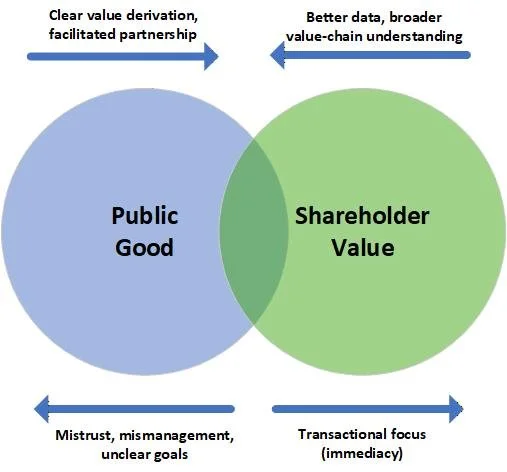
To accomplish this, we need to make the case. We need to provide better data and analysis on why it is of interest to shareholders to invest in what has historically been treated as the domain of government and non-profits, and to help make the case that public goods can increase shareholder wealth. At the same time, we must also identify ways to catalyze engagement, while also being aware of the incentives that may drive us away from public good.
One this is clear, the private sector is coming, and the money is getting ready to flow to climate adaptation in ways that are only just emerging. With good data and broader understanding of the value relationships between public good and wealth creation, we have an opportunity to be transformational in building a more resilient future for everyone.