Recovery Isn’t Recovery: How Disasters Quietly Shrink Economies
By: Gunjan Saxena
Disasters don’t just cause temporary economic shocks, they permanently reduce economic output as recovery diverts resources away from long-term growth and repeated shocks prevent catch-up.
Across decades of research, from global studies to country-level analyses, a consistent pattern emerges. Disasters cause a short-term drop in growth, followed by a rebound. On paper, recovery happens; however in reality the lost ground is never fully regained.
Recovery isn’t really recovery.
Economists distinguish between growth rates and growth levels. Growth rate may bounce back after a disaster, but the level of economic output remains permanently below where it would have been.
The following is an excerpt from The Impact of Natural Disasters on Economic Growth. GDP per capita post shock shows a similar trend line as pre-shock, but shifted downward.
Figure 1: Real GDP Per Capita Growth and Level around a Natural Disaster: 20 Largest Disasters
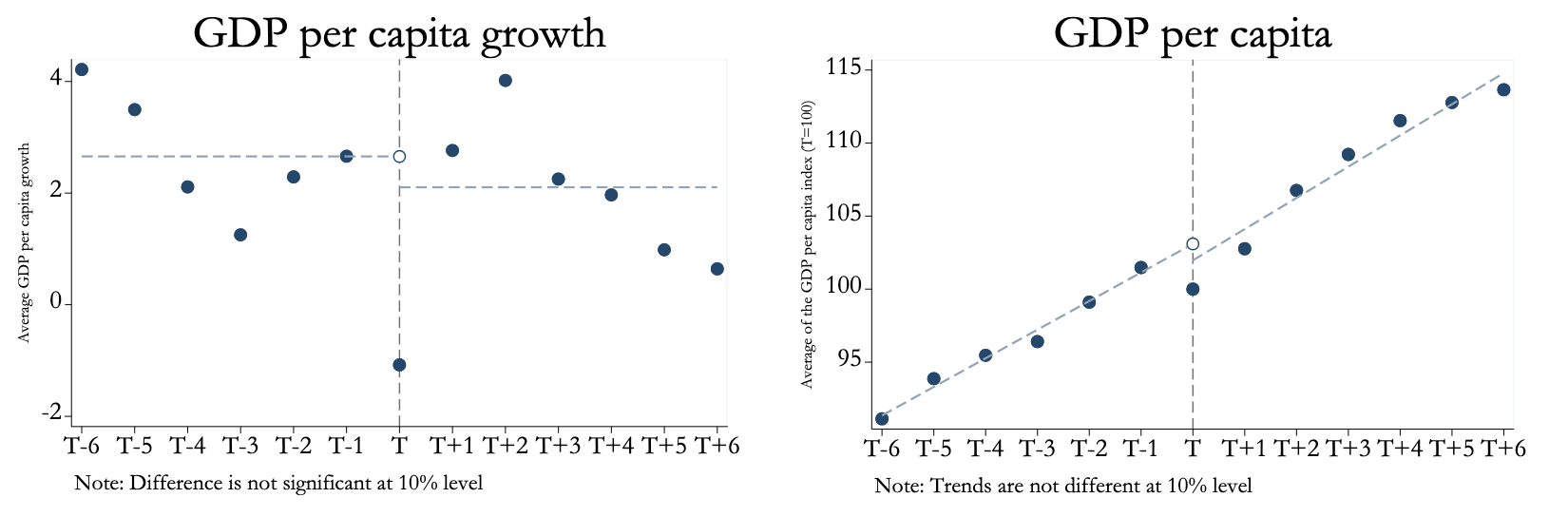
Source: Eduardo A. Cavallo, Oscar Becerra, and Laura Acevedo, The Impact of Natural Disasters on Economic Growth (Inter-American Development Bank, 2021)
Recovery looks stronger than it actually is partially due to how we measure economic activity. Rebuilding efforts (e.g., repairing homes, reconstructing infrastructure, replacing damaged capital, etc.) show up as positive contributions to GDP. But this spending doesn’t represent new wealth; it merely replaces what was destroyed.
This creates the illusion of strength and resilience post-disaster as construction and government spending surge. However, resources get directed away from productive investment (e.g., innovation, expansion, and long-term growth) and toward recovery.
The impact of this illusion results in businesses often delaying or cancelling new investments due to insurance costs, disrupted supply chains, and increased uncertainty. Meanwhile, governments are forced to reallocate budgets to disaster recovery at the expense of other growth-enhancing priorities.
Following excerpt from Understanding the Macroeconomic Effects of Natural Disasters shows how advanced economies tend to recover more quickly with governments being able to step in immediately, stabilizing output and offsetting losses. In many developing economies, however, the story is different. Government spending often lags, investment collapses more sharply, and key sectors can take years to recover.
Figure 2: Impact of Natural Disasters on Growth of Output and Components
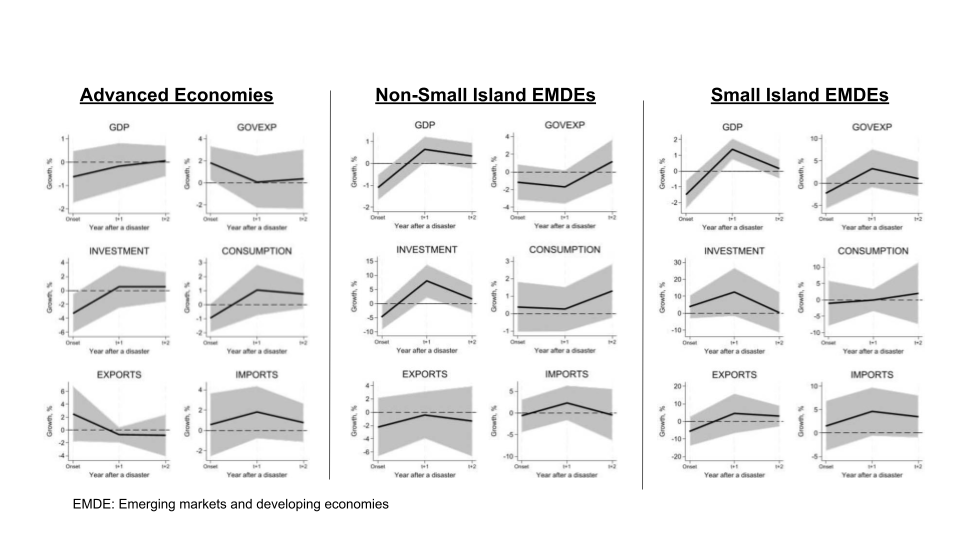
Source: Ha Nguyen, Alan Feng, and Mercedes Garcia-Escribano, Understanding the Macroeconomic Effects of Natural Disasters (IMF Working Paper WP/25/46, 2025)
Additionally, the nature of disasters is changing. Climate-related risks are becoming more frequent, more severe, and more interconnected. Economies may begin rebuilding just in time for the next disaster to hit.
Along with the direct / physical impact, indirect effects of disasters accumulate over time. Rising temperatures reduce labor productivity, especially in agriculture and construction sectors; population shifts strain urban infrastructure; and financial systems face growing exposure to climate-related risks, including declining property values.
If disasters are more permanent setbacks versus temporary shocks, the policy response must change. Policy focus cannot be solely on recovery, but rather towards resilience.
Resilience-focused policy includes investing in stronger infrastructure, expanding access to financial tools like catastrophe bonds to spread risk more effectively, and recognizing that prevention is not just a humanitarian priority, but an economic one.
The real cost of disasters isn’t what they destroy, it’s what they erase from the future.
